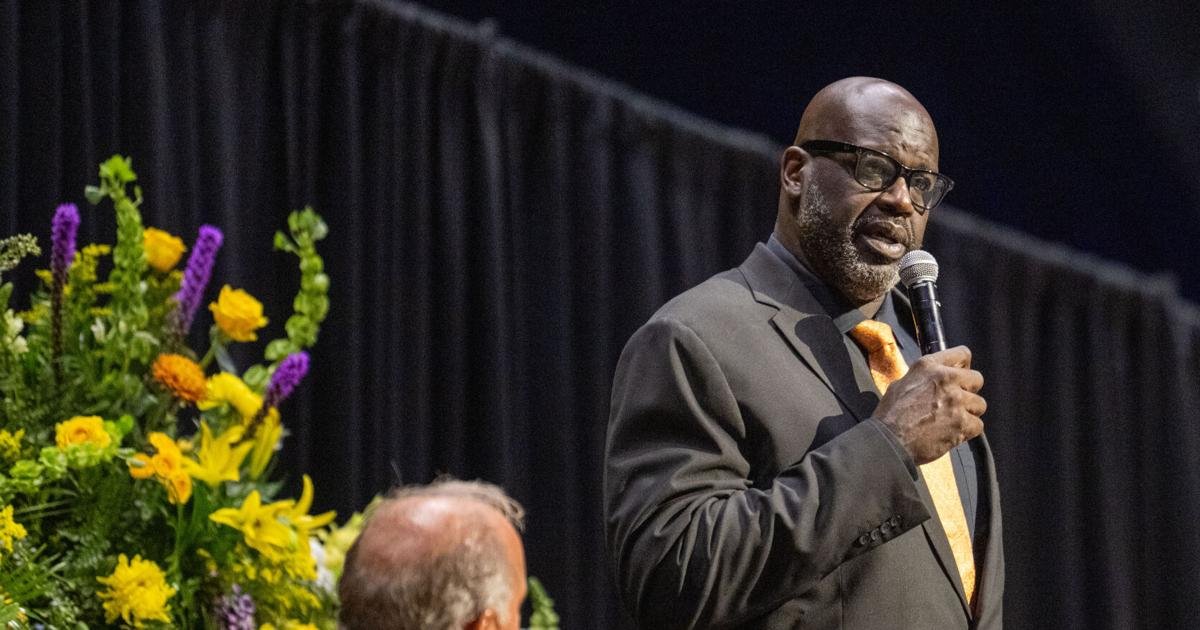

LSU and NBA legend Shaquille O’Neal speaks at a celebration of life for former LSU coach Dale Brown on Wednesday, Nov. 11, 2026, at Pete Maravich Assembly Center.
From its opening day, LSU’s Pete Maravich Assembly Center was nicknamed “The House that Pete Built.”
Fitting enough. “Pistol Pete” was and still is the greatest scorer in men’s college basketball history.
But the men’s basketball program that makes the PMAC its home was built by Dale Brown. Fitting enough that his name is on the arena’s hardwood court and hangs on a banner from its rafters.
Wednesday night, memories of Brown filled the PMAC one last time as family, former players, coaches and friends celebrated the legendary coach who died Oct. 23 at age 90.
“We’re in this building where all of us, if you were a part of LSU basketball, somewhere you have a visual of coach Brown,” said Ricky Blanton, who played for Brown from 1984-89 and helped lead the 1986 Tigers to the Final Four. “It’s only fitting. We’re celebrating in the proper place.”
In his 25 years as the LSU coach from 1972-97, Brown breathed life into what for most of its existence had been a moribund basketball program. He led the Tigers to 448 wins, two Final Fours, four Southeastern Conference regular-season titles and the program’s only SEC Tournament championship.
A parade of Brown’s former players took to the podium to share memories of their beloved coach. Some amusing, some poignant.
Among the best stories was the biggest figure (literally) from Brown’s career, Hall of Famer Shaquille O’Neal. He told the familiar story of Brown coming to do a camp at the military base in Germany where Shaq’s father was stationed, and how that started a lifelong relationship between the coach and the then-13-year old who would grow up to be an all-time basketball great.
“He was the first person in my life who believed in me,” O’Neal said. “Dale would write me every Friday. In one of those letters, he offered me a scholarship.”
O’Neal won four NBA titles and an Olympic gold medal. But the player who Brown helped build up is still bothered by the fact he couldn’t help his coach win a national championship.
“My only regret,” Shaq said. “He’ll be missed. But he’s inside all of us.”
Anyone who knows anything about Brown knows he was about much more than basketball. It was a fact that one of his greatest players, Rudy Macklin, learned from the start when Brown was trying to pry him out of Louisville, Kentucky, in the mid-1970s to play for a program that had yet to win.
“I’d get these letters, poems, essays” from Brown, Macklin said. “I thought, ‘This guy is paying a fortune in postage.’ My dad started reading my mail (from LSU) before I got them.”
Nationally ranked programs were lining up to recruit Macklin. Brown, unlike other coaches, sat down to lunch with the Macklins on his in-home visit. It made a lasting impression on Rudy’s mom.
“I said, ‘Mom, Marquette is coming,’ ” Macklin said. “She said, ‘I don’t care, I like Dale Brown.’ ”
Macklin went to LSU and was the star of Brown’s greatest team, the 1980-81 Tigers that went to the Final Four and won a program-record 31 games.
Like Shaq’s story, Macklin’s journey to LSU was a familiar one. The kind of story you expected to hear from one of Brown’s most legendary LSU stars. But the full picture of Brown came from an unexpected source, a minister from Cary, Illinois, named Cary Hughes.
As a third grader growing up in Baton Rouge, Hughes had a school assignment to interview someone he wanted to be like. He wrote Brown, who in March 1993 welcomed him into his office at the PMAC.
“He looked me in the eye and said, ‘Young man, never forget, God doesn’t make any junk. You are a gift and you belong to him,’ ” Hughes said.
Hughes said his parents later sent Brown some money to thank him for his time.
“He sent it back with a note that said, ‘Please give this to a poor family. Dale.’ ”
Brown was such a force of nature, it almost seemed incongruous that the arena that he brought roaring to life as the “Deaf Dome” was draped in black, with black folding chairs for the attendees resting atop the hardwood.
The fire that Brown lighted in so many people who came through his program, through his life, shined through the gloom, though. How could it not?
“Daddy Dale’s legacy has nothing do with basketball and box scores,” said Jordy Hultberg, a player and assistant coach under Brown who now is on the LSU radio broadcast team. “It’s the lives he changed. He was a mentor who always led with his heart.
“Tonight is not about mourning a loss. It’s about celebrating 90 remarkable years of passion, loyalty and love.”
Legendary broadcaster Bob Costas, a longtime friend of Brown’s, sent a video message that was played during the ceremony.
“Jackie Robinson said a life is not important except in the impact it has on other lives,” Costas said.
Maybe, like Shaq said, Brown never got that national championship.
But the memories shared Wednesday night in the PMAC proved he lived an important life.
#Memories #fill #arena #Dale #Brown #helped #fill #time #LSU
Source link