When a boar emoji popped onto Jackson Harris’ phone, he knew what it meant.
Hawaii receivers coach Jared Ursua created a context by playing the guttural snorts, growls and grunts of the tusked pig for the Stanford transfer, who had healed from a preseason hamstring injury in the fall of 2025 but wasn’t letting loose like he needed to.
Heading into a career-altering season, Harris’ choice was fight or flight.
“If we were on a hike, and you heard the boar noises, what are you gonna do?” Ursua asked.
“I’m gonna run,” Harris replied.
“Well, what are we doing?” Ursua followed up, literally and then figuratively as he started texting Harris boar emojis as a mental cue. “Get your butt going and let’s go.”
Ever since, Harris has been running full speed for his football life, all the way to LSU, hurdling over barriers that could have cut down a lesser-motivated person.
He was a late arrival to the game, playing soccer through middle school because his mother, Betsy, didn’t want him in contact sports.
He argued his way onto the football team in ninth grade, but a burgeoning 6-foot-2, 205-pound wideout with fast feet was barely recruited until his senior year.
Harris had just six catches in two seasons at Stanford, sojourning to Hawaii to revive his college football dreams. He totaled just under 100 receiving yards through a handful of outings with the Rainbow Warriors, but once his hamstring healed, and he found his top gear, he logged seven 100-yard games in his next eight contests.
He was big and strong enough to win jump balls, but Harris was more likely to take a curl route, juke a defender out of his shoes and outrun everyone up the sideline.
Like an ornery boar was chasing him.
“The H on our helmet was for Harris,” Ursua said, “because that kid was hooping.”
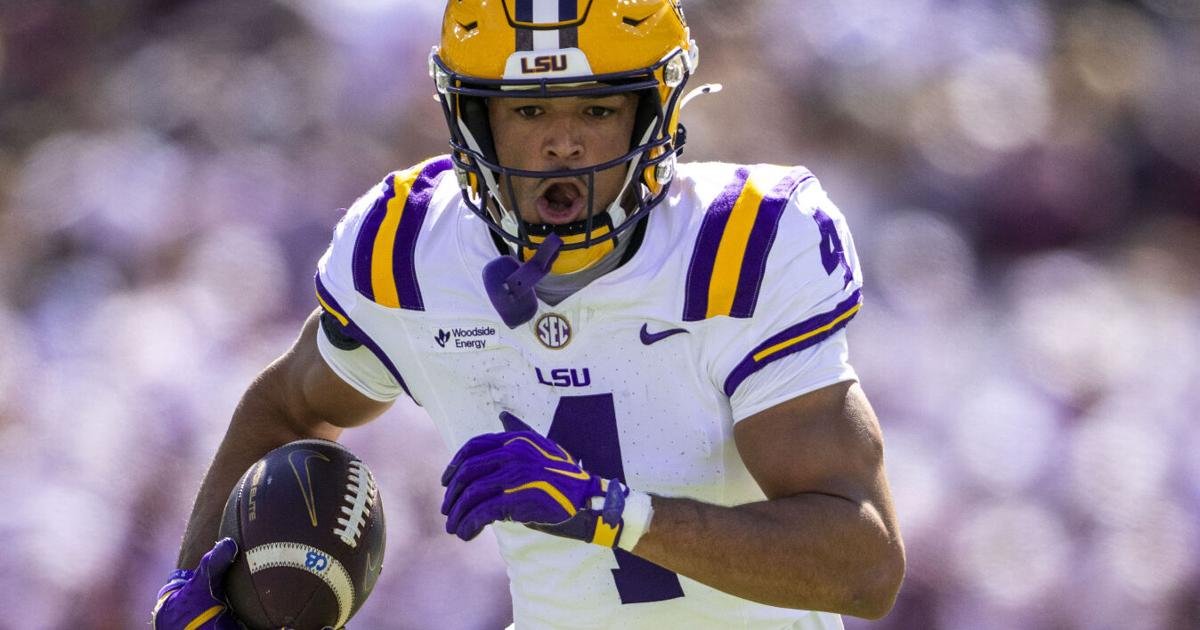
L, S, and U suit Harris too. He has 800 yards and seven touchdowns in nine games, burning through SEC secondaries as he did the Mountain West Conference.
He’s such a wild success story, Harris had to pause and take a deep breath Tuesday as he reflected on his career. He was sitting in LSU’s receiver room with depictions of Ja’Marr Chase and Justin Jefferson on the back wall.
“You go from high school, where I’m barely recruited, to having every school in the country wanting you to come sign,” Harris said. “Then it’s like, this is Wide Receiver U, you can look at the wall behind us. How do you compare that to anything?”
There is no other path Harris would have rather taken than the one that led him here.
Those imaginary boars snarling in the bush.
Pleading his case
Harris is accustomed to going his own way.
The native of Berkeley, California, is a Bears fan. But not Cal, even though the university was just down the road from his high school. He liked the Chicago Bears, even if the San Francisco 49ers regained their popularity during the Kyle Shanahan era.
“The more people around Jackson got hyped about the Niners, the less he liked them,” said his father, Anthony Bush, a Chicago native who passed down his NFL fandom.
What he couldn’t as easily offer Jackson and younger brother Jalen, now a running back at Fresno State, was an opportunity to play the game.
They were in flag football leagues, but not the tackle variety.
“I encouraged (their mom), ‘Let’s rethink this a little bit.’ They’re very passionate about it,” said Anthony, a teacher by trade. “They want to play.”
Jackson can be quiet, but he wasn’t about this. He confronted his mom Betsy, telling her bluntly, “I’m going to play football, whether you like it or not.”
Anthony cheered his son’s rebellion.
“Right on,” Anthony recalled with uproarious laughter. “He said, ‘I’m going to do it no matter what,’ and he told his little brother, ‘And you’re coming with me.’”
Jackson’s career at Berkeley High School, not exactly a winning program, started during the COVID-19 pandemic. He had no idea what he was doing on the field. By his junior year, he figured things out, but he broke a finger, limiting him to four games.
Harris had no big-time offers as a senior, which stunned Berkeley’s new head coach, David Perry, when he first had a look at the wideout. He was halfway convinced his team’s defense was awful because of how easily Harris shredded them.
“Some kids, they’re so fast, you have the live feed and they leave the screen,” said Perry, who recalled how quickly Harris lost Berkeley’s cameraman on a screen pass early in the season. “He makes two moves back inside, then a third move back inside.”
“Right after that game, I said, ‘Make your highlight tape,’” Perry continued. “I’m gonna send it out to every coach that I know.”
Harris racked up a state-leading 1,492 receiving yards and 24 touchdowns that year, but it still took weeks for coaches from Stanford, Cal and UNLV to pack the stands to watch him. In that game, Harris caught two touchdowns, returned two more for touchdowns, and threw a two-point conversion pass right before halftime.
Perry turned to then-Stanford receivers coach Bobby Kennedy like Maximus from the movie Gladiator, asking his onlookers “Are you not entertained?”
“What else do you need to see?” Perry shouted. “Offer him!”
Kennedy obeyed. Harris accepted.
The trouble is, David Shaw was no longer Stanford’s head coach when Harris arrived. His whole staff, including Kennedy, was displaced. Plus, Stanford had a future Tennessee Titan, Elic Ayomanor, at outside receiver.
“You’re not doing anything wrong. You’re just not their guy,” Perry told Harris. “All the guys that recruited you left. It’s the beginning of the NIL era, they promised you nothing, but they’re promising new kids something.
“You gotta figure out if a Stanford education is more important than playing football.”
Harris wouldn’t have rebelled against his mother if football meant anything less.
It was a rough start, but Harris doesn’t regret his time at Stanford. He learned from Ayomanor, an exceptionally hard worker. He’s still friends with Emmett Mosley, who transferred to Texas, which is LSU’s next opponent.
“I wouldn’t be here if I didn’t go there,” Harris said. “It’s all a blessing.”
Running with the boars
When he went into the transfer portal in December 2024, Harris’ highlight reel consisted of just two game clips.
There was a leaping, 44-yard reception against Washington with a defender draped on his back, plus a 3-yard touchdown versus TCU, stopping his route between two Horned Frogs and falling to the ground as he absorbed a dart of a pass.
That was it.
But at least Harris started that TCU game. Ursua considered that noteworthy, because he understands there’s a thin line between starting and falling deep down a depth chart in Power Four football.
“Just kind of got lost in the sauce,” said Ursua, who had Harris send him 1-on-1 reps from Stanford practices and speed data from his Catapult vest. “It became very evident that he had all the skills, just needed a little bit more time, a little bit more development.”
Ursua didn’t have a difficult sell because Hawaii head coach Timmy Chang, a former Rainbow Warrior quarterback, likes to throw up 50 passes a game. Harris was so anxious for an opportunity, he didn’t even ask about NIL pay.
When he arrived on the island, he camped out on Ursua’s office couch, wanting to talk ball.
“He’s a football guy,” Ursua said.
Harris’ soccer background just afforded him quick feet, which Hawaii’s coaches noticed immediately during spring practice. Defenders couldn’t stay in front of him, and he was too strong to grab onto as he was flying past them.
“At LSU, you have dozens of those guys,” Ursua said. “We don’t necessarily have dozens of them. But we’ve had really, really good ones.”
Harris would prove himself to be a great one, battling through early hamstring troubles to post six catches, 59 yards and a touchdown in a 23-20 win over Stanford in the opener.
He took it easy over the next three weeks, collecting just 38 yards, but Harris exploded with 144 and two touchdowns at Air Force. On his way to 963 yards on the season, Harris had four games with at least one catch longer than 70 yards.
Many of those were short throws where he just ran away from the defense.
And maybe an imaginary boar or two.
“Once he felt that sense of confidence,” Ursua said, “it was over.”
On to the next step
In just one year, Harris’ career at Hawaii was over.
But that doesn’t trouble Ursua. This is a unique era, and Harris is a unique athlete.
“There’s tiers to this thing,” Ursua said. “Once upon a time, we wanted to develop guys and get them to the National Football League. That’s just tough to do when these Power Four teams can provide financial assistance the way that they can. So in some sense, we are helping them get to a different pro level.”
When LSU and Lane Kiffin came calling, Harris was off to Baton Rouge.
Ursua cheered him on, tagging his star pupil’s commitment to LSU and telling other athletes to “Portal to Paradise” for a career reboot.
This season, the Rainbow Warriors have receivers formerly of Oklahoma State, Iowa State and Virginia Tech on the roster.
“They all want to be the next Jackson Harris,” Ursua said. “The one thing that he did that was incredibly unique is he worked his tail off in every way.”
For that reason, there are still plenty of Harris fans in Hawaii. Last weekend, the Rainbow Warriors didn’t kick off with UTEP until late at night, which offered some downtime for Ursua to watch LSU-Alabama in the afternoon.
This might be hard for some prideful, competitive coaches to admit, but Ursua took note when ABC color commentator Kirk Herbstreit called Harris “the Hawaii transfer.”
“I don’t blush too often,” Ursua said, “but that was one of the moments that I thought, gosh, that’s pretty cool.”
Just as cool was watching Harris haul in short passes, like he did at Hawaii, and juking out Alabama defenders on his way to long gains. He followed 178 yards at Auburn with another 166 versus Alabama.
The momentum Harris created at Hawaii hasn’t stopped. He’s not only emerged as LSU quarterback Sam Leavitt’s favorite target, but there is suddenly discussion about whether the Hawaii transfer will be one-and-done in Baton Rouge too.
The NFL might want him sooner rather than later.
He’s been on quite a journey these last few years, but Harris isn’t overly verbose about it. After a dozen minutes reminiscing Tuesday, he was asked if there was anything else interesting about his story that was missed.
“I just work,” Harris said, letting out a big laugh. “That’s it.”
Ursua was also asked if he had anything more to say about the receiver he helped revive.
“That’s plenty of Jackson Harris talk for one week,” the Rainbow Warriors’ passing game coordinator joked. “Unless you’re going to let me borrow him, I’m good.”
#Lane #Kiffin #LSUs #top #Hawaii #Heres #story #LSU
Source link