ASML’s unique success has helped build an influential and lucrative network of companies and institutions devoted to semiconductor technology in and around Eindhoven, and it’s a model for what Europe is trying to achieve with photonic chips.
The Eindhoven project has the backing of former ASML chief executive Peter Wennink, author of an influential report for the Dutch government called The Roadmap to Future Prosperity, external, which noted that the market for photonics was expected to grow 10 to 20 times in the next 10 years.
In a news release backing the new pilot line, Wennink described it as “a launchpad for Europe’s future digital economy”.
“By investing in scalable production capacity, we are creating an ecosystem that can help shape the global technological direction,” he said.
Of course, Europe is not alone in looking to the potential of photonics to earn a global economic advantage.
In June this year, US photonics company Coherent, external announced what it called “the world’s first and largest volume-production six-inch indium phosphide manufacturing platform” at its plant in Sherman, in Texas.
The expansion is backed by chip manufacturing giant Nvidia, as well as $50 million public funds under the US Chips Act.
It’s an illustration of how quickly the market is moving, and how central photonic chips could be to the continuing race to retain an influential stake in AI and technological development more generally.
Europe’s bid to establish itself as a global leader in photonic chips – exemplified by the Eindhoven project – is the kind of strategy that makes sense in a globalised economy, says Joris Teer, policy analyst at the European Institute for Security Studies in Brussels.
If the continent can take a lead in photonic chips, then future developments in AI and data will partly be dependent on Europe.
“Europe knows that its high energy and labour costs, skilled workforce shortages, and lack of private and public capital make an across-the-board reindustrialisation strategy impossible”, Teer says.
“To retain influence, ensuring dependence on European parties rather than European autonomy is key.”
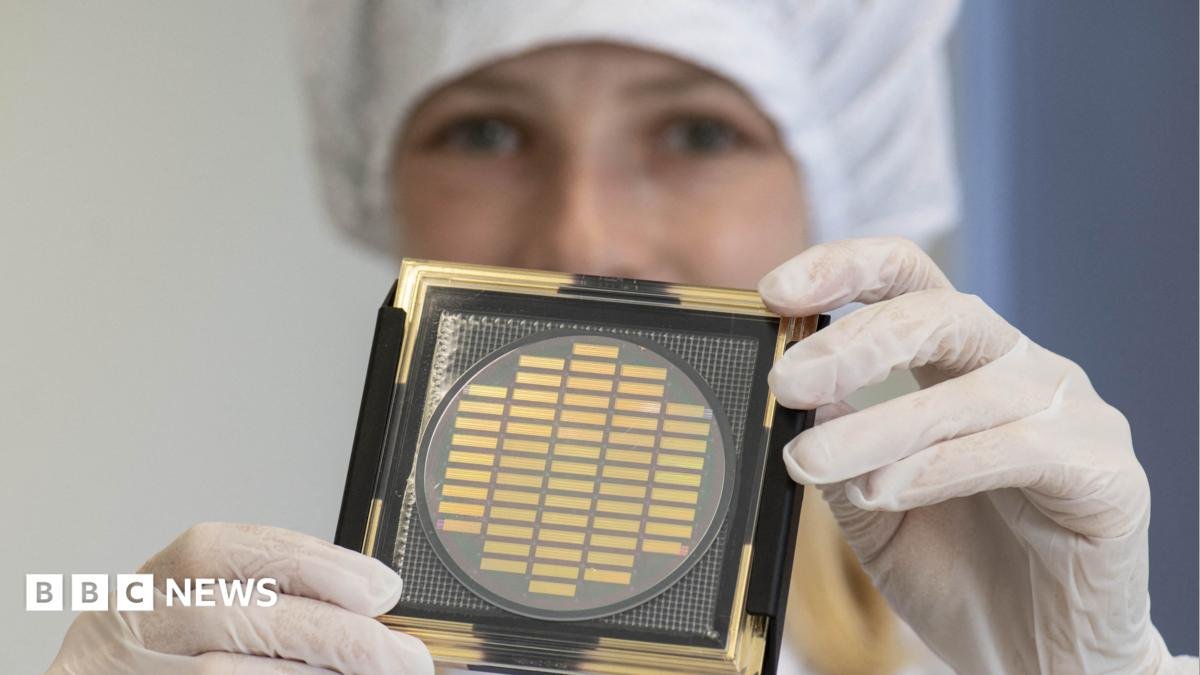
Once up and running, the Eindhoven project will provide a pilot production line which can be used multiple companies.
It will be open to businesses across Europe and beyond, who can design and build chips without having to develop their own expensive production facilities.
“What we want to establish here is what we call a foundry model; there’s no intention to have our own product,” Ton van Mol says.
Instead, they will produce to order for outside customers.
It’s the same idea which, at huge scale, has brought Taiwanese-based giant TSMC a position of global dominance in the manufacture of microchips.
Photonic chips are already in use, in highly specialised areas in data centres and in Lidar (light detection and ranging) sensor technology, for instance.
For van Mol of TNO, helping the industry to scale up, by easing production challenges and increasing capacity, is the key step to moving them into the tech we use in our daily lives, like phones and laptops, and to drive innovation in areas like medical scanners and 6G communications.
“The demand is there”, says van Mol, “and the end goal is to have, in Europe, manufacturing of these chips, which is strategically very important because these chips [could] become the backbone of all data and telecom.”
#Europe #plans #catch #computer #chip #wave
Source link