Sometime before LSU lost to Kentucky in October, coach Lane Kiffin looked at the numbers and saw something that impressed him. His new-look program was ranked No. 1 among Southeastern Conference teams in both offensive and defensive yardage.
There was one small problem, though. The Tigers’ scoring numbers hadn’t quite kept up with the yardage stats. They were solid. They just didn’t stand out as much as they should have, which told Kiffin that LSU had something to work on as it geared up for a difficult November.
“Man, we do really good things,” he said Oct. 12, “and then we don’t finish drives on both sides of the ball well enough.”
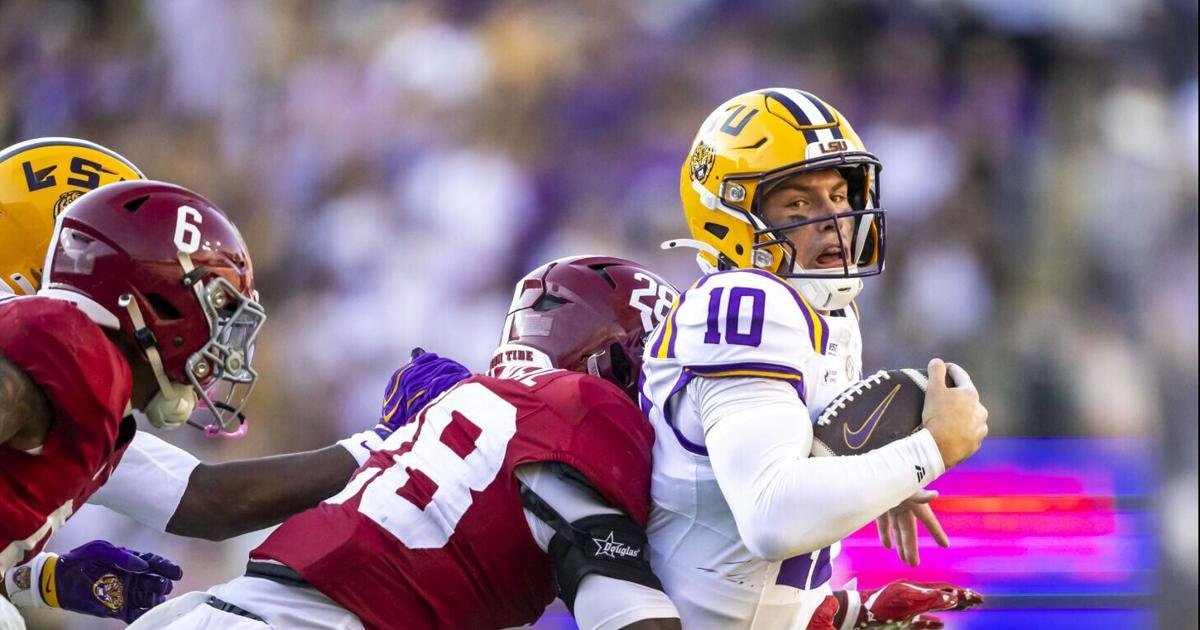
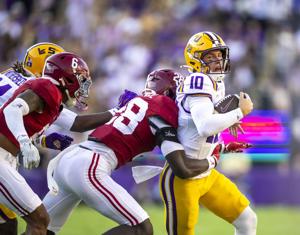
That comment, as it turns out, proved prescient. LSU has had to battle some simmering red-zone issues all season, and they finally boiled to the surface on Saturday, when Alabama handed the Tigers their third loss of the season by out-executing them inside the 20-yard lines — on both sides of the ball.
LSU piled up 172 more yards and picked up 14 more first downs than the Crimson Tide.
But Alabama still left Tiger Stadium with a commanding 31-13 win.
It was a head-scratching outcome, one that you could explain only by looking at how each team fared in the red zone. The Tide scored on all three of their trips inside LSU’s 20-yard line. The Tigers, on the other hand, marched into their red zone four times and came away with only a touchdown, a field goal and two turnovers on downs.
Now, ahead of a must-win home game against Texas that kicks off at 6:30 p.m. Saturday (ABC), LSU has to improve in one key area if it wants to preserve whatever’s left of its College Football Playoff hopes.
“On both sides,” Kiffin said, “offense and defense, we played really poorly in the red zone.”
LSU’s overall red-zone numbers look OK. Kiffin’s offense has scored a touchdown on 67% of its trips inside the 20, which ranks 44th among FBS teams and seventh among SEC teams. On defense, the Tigers have allowed their opponents to score touchdowns on 56% of their red-zone drives, which ranks 49th in the country and ninth in the SEC.
The Alabama game is skewing the numbers. In the other six contests LSU played against power-conference teams, its offense found the end zone on 18 of 26 red-zone drives (69%), and its defense prevented opponents from finding paydirt on nine of the 18 possessions it allowed to reach the 20 (50%). Not bad.
So, where are the issues?
Just look at the 23 drives (in games against power-conference opponents) in which LSU’s offense has reached the 10-yard line. The Tigers have punched into the end zone on only 13 of those possessions.
LSU stalled within 10 yards of the end zone twice against Ole Miss, twice against Kentucky and three times against Alabama.
The Tide forced the Tigers into a field goal and a turnover on downs on two of their first three drives.
Had those possessions turned into one or two touchdowns, the game would’ve followed a different script.
“They took the bye,” Kiffin said, “and did a lot of things in different ways that they had never done. Really, things that normally we pick up on and come to, they had a really good plan for, and they executed really well.”
“The little bit we tried to run the ball fringe red zone, we weren’t very good, which made us kind of one-dimensional with the rush down there also.”
Kiffin said Oct. 12 that he thinks LSU struggled to score at times because “things happen fast in the red zone.” Quarterback Sam Leavitt had done some “really good things” inside the 20, he said, but he had also “missed a couple guys,” in large part because defenses were forcing him to “go really fast.”
“So, he’s just gotta get better,” Kiffin said.
Leavitt could also use a hand from LSU’s running backs, who piled up only 61 yards on 18 carries against Alabama. The ground game has been a quiet issue for the Tigers in recent weeks. LSU averaged 238 rushing yards per game in its first five matchups, but in its last four, it averaged only 106 rushing yards per game.
“A lot of times we’re just missing plays,” Kiffin said on Oct. 12. “I know that sounds really general.”
But all it takes, as Kiffin said then, is missing a few open receivers or whiffing on a few key blocks in the red zone for a small issue to turn into a bigger one.
“So, it’s a problem,” Kiffin said.
One that LSU needs to solve if it wants to knock off the Longhorns.
#LSU #footballs #redzone #issues #run #deeper #LSU
Source link