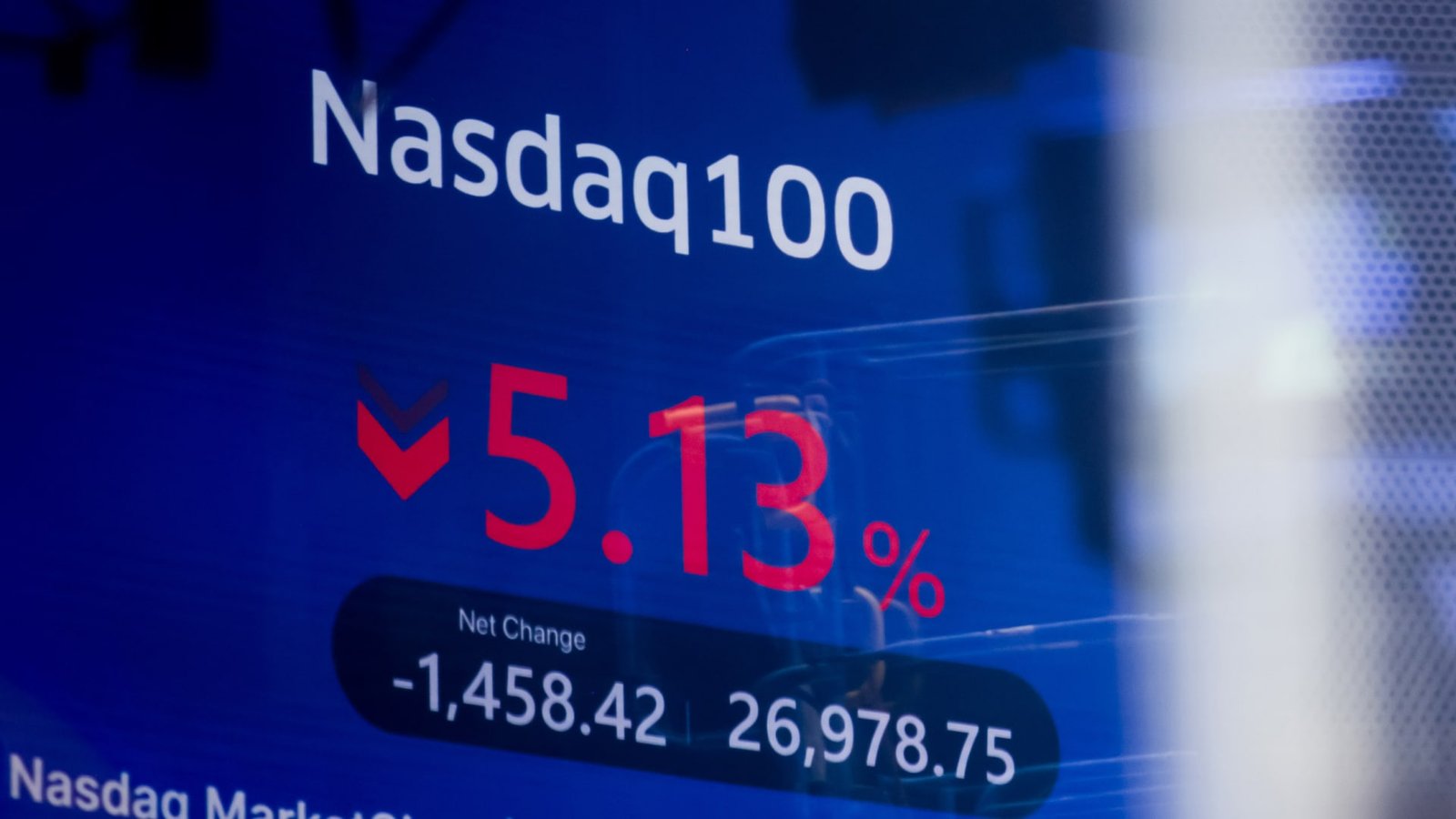
Signage at the Nasdaq MarketSite in New York, US, on Thursday, Nov. 5, 2026.
Michael Nagle | Bloomberg | Getty Images
As a post-midterm rally Wednesday turned into a steep sell-off Thursday, tech executives sought to look through the notion that potential data center constraints could be catastrophic for their businesses.
In response to a Democratic sweep of Congress as well as a sizeable number of state governorships and legislatures in the midterm election Tuesday night, stocks initially rallied Wednesday, posting their best day in more than 18 months as President Trump accepted the blowout results with little fanfare.
The tide quickly turned Thursday, however, with stocks selling off sharply as investors feared a potential slowdown in the data center build-out after wins by candidates in favor of data center regulation in states like Texas and the possibility that the artificial intelligence trade may be past its peak. Tech led the sell-off, with the “Magnificent Seven” losing over $1 trillion in aggregate market cap.
Stocks recovered some of their losses Friday.
Here’s how tech executives reacted to the midterms and sell-off threat:
Arm CEO Rene Haas

Haas characterized the postelection fear as “very, very short term thinking” and not likely to be a major threat to Arm’s business in the long term, but said the U.S. must keep investing in the data center build-out before the rest of the world catches up.
“If the U.S. hesitates in any way, shape, or form in terms of data center build-out, the rest of the world is ready and willing. There is just huge demand for this capacity,” Haas told CNBC’s “Squawk on the Street” Thursday.
OpenAI CFO Sarah Friar

Friar told CNBC’s Sara Eisen Friday that OpenAI will continue investing in data center infrastructure after voters resoundly rejected data centers in their backyards during the midterm election. The company will also focus on community concerns, including electricity. “We will never raise your electricity bill,” Friar said.
“When I think about the midterms, I need to keep thinking about how do we keep investing to meet that customer demand. It starts early with having built relationships with all of the hyperscalers, and it will continue to mean that we raise capital,” Friar said.
“If the midterm means more focus on data centers and communities, we’re going to keep doing the work to get into those communities and to build trust with them.”
Qualcomm CEO Cristiano Amon

Amon said the anxiety about the future of the data center build-out doesn’t pose a significant threat to the chipmaker’s business, as data center infrastructure is just one segment. Qualcomm slid 9.49% in Thursday’s sell-off before recovering some losses Friday.
“The whole market is down, but I think the Qualcomm story is a little bit different,” Amon told CNBC’s Jon Fortt Thursday. Unlike traditional PC and data center chipmakers, Qualcomm has historically focused on low-power consumption computing. “The story of Qualcomm is what we have done outside that on the data center specific question.”
Box CEO Aaron Levie

Levie told “Squawk on the Street” Thursday that productivity gains meant AI “is clearly going in one direction,” but said a tendency for industry messaging to coalesce around “doomerism” can exacerbate the public perception problems AI companies face.
“I think it’s a little bit easier to rotate it toward maybe the more risk-oriented messages, and that’s something that our industry needs to work on clearly. But ultimately, obviously, the consumer needs to see the direct benefit, and that’s something that will just take time,” said Box’s Levie.
Lyft CEO David Risher

Risher said the dour market sentiment wasn’t concerning for Lyft’s business, as consumer sentiment and bookings remained strong.
“I wouldn’t get too distracted about the short term stuff of what’s going on in the market. If I look at the consumer, for example, we just had the biggest Halloween we’ve ever had,” Risher told CNBC’s “Squawk Box” Friday.
#OpenAI #Arm #Qualcomm #Box #execs #react #midterm #selloff #concerns
Source link