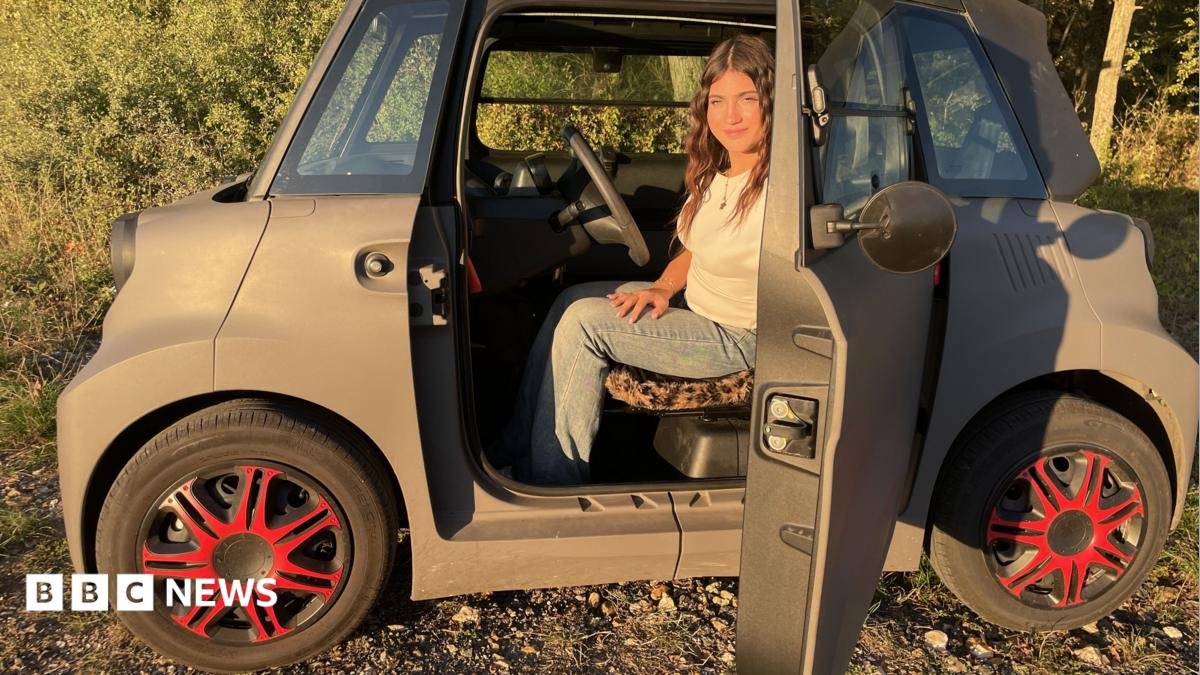
Another local Daniel Laprès, who drives a micro-car made by French firm and market-leader Aixam, tells me he actually pulls over to let the cars behind pass.
He and his wife moved from Paris to this country village two years ago. Of Canadian nationality, he didn’t swap his foreign licence for a French one in time and lost the right to drive. That didn’t matter much when he was in Paris. Like many Parisians he didn’t need a car. He used public transport. But that’s not possible here.
“We tried living off of taxis and it was in the end a disaster. Then we heard about how you could drive without having to have a licence, and it was the exact solution to our problem. Cheap, inexpensive to operate, basically no administrative formalities, you get insurance.”
However, Laprès feels less safe in his small car. “They’re little more than tin cans on wheels, right? I mean, you’re not going to be driving fast, but someone else could be.”
These cars are forbidden on motorways. But even on medium-fast roads, being considerably slower than the average vehicle can be a problem.
“You go on national highways at your risk and peril. I did it once and I will never, ever do it again. On those roads (speed limit 110km/h), everybody is passing you, including the biggest trucks. And they come at you very fast from the rear, so it’s scary,” Laprès says.
Daniel is 77 so fits in with the long-established market for these cars: older people living in the countryside.
Traditionally the market also included quite a few people who’d lost their licences, often because of drink-driving offenses. But the launch of the electric Citroën Ami in 2020 changed the customer profile and the product.
“The launch of the Ami was the beginning of the transformation of the sector, with more and more electric models coming on to the market. In 2026, more than 67% of new licence-free cars are electric,” says Marie-Laure Nivot, market analyst at AAA Data.
#tiny #cars #Europe
Source link