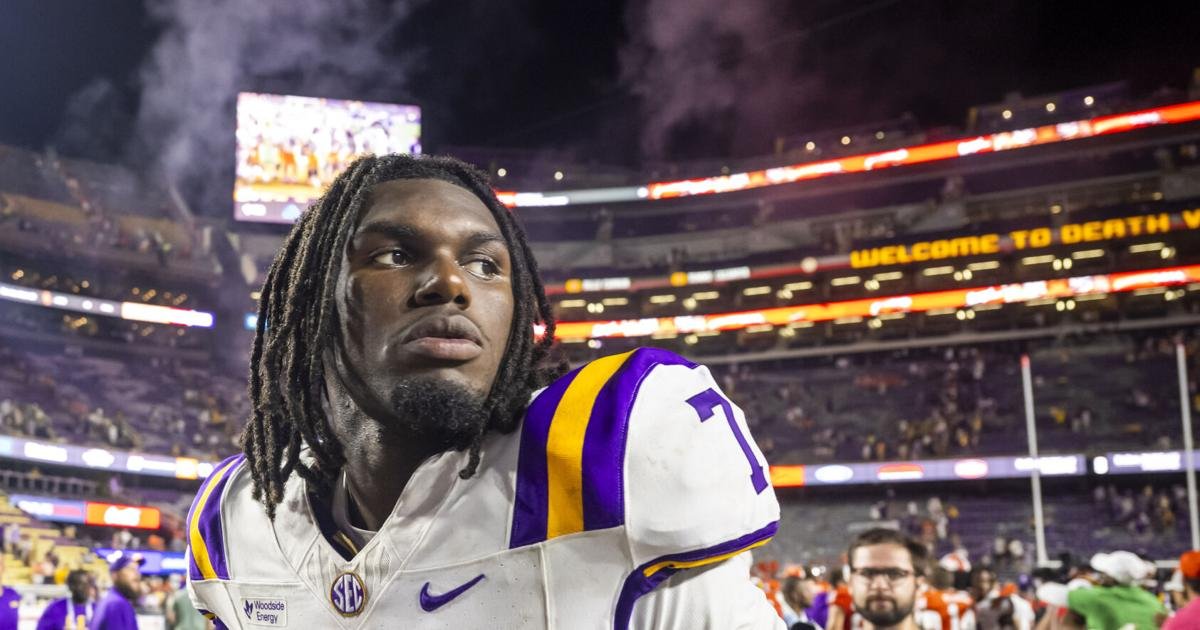
All 6-foot-7, 242 pounds of Trey’Dez Green was propped up by crutches as he met his mother in a stadium tunnel at Ole Miss. His head dropped onto her shoulder.
“That next play,” Green said, crying, “was mine.”
He so badly wanted it to be. The pride of the two-stoplight town of Jackson, Louisiana, was a catalyst in his dream school’s rally from 17 points down, including a 19-yard catch and run that had LSU rolling toward another score in a 24-24 game in the fourth quarter.
Quarterback Sam Leavitt would have been looking for his long, athletic tight end in the end zone, undoubtedly, if Green wasn’t knocked out after taking an Ole Miss tackler’s helmet to the knee.
LSU’s drive stalled. Ole Miss won 32-24.
“He didn’t say, ‘Mama, I’m in so much pain,’ this or that,” Casondra Green said. “He said, ‘That next play was mine, mama.’ I said, this child, he is so dedicated to the game.”
There was no doubt when Green returned a month later, a brace still wrapped around his right knee, and rumbled for 50 yards and a touchdown at Auburn. He had come back sooner than his mom would have preferred.
But at least he came back at all.
There was reason for pessimism on Sept. 19 in Oxford, Mississippi, as Green’s knee was examined. His MCL was intact, but the doctors couldn’t rule out an ACL tear.
“There was fear, but I had to double down on my faith,” Green said, “and know that God has a better and bigger plan for me.”
When an orthopedist examined Green’s MRI results the next day, there was enough surprise that one member of LSU’s medical team asked, “What kind of body do you have, Trey’Dez?” He deferred credit for his merely sprained ligaments, saying “That’s God.”
“The doctor said, ‘Man, I think this is gonna be something bad. Plan for the worst,’ ” said Chad Hardy, a longtime AAU basketball coach who was in the tunnels of the Ole Miss stadium when Green came off the field. “Got there the next day, man, nothing was torn, just a sprain. I said, ‘Thank you, Jesus.’
“God’s gonna take care of ones that treat people (right) and do good things, right?”
Hardy knows his protege, who he has coached since the age of 6, hasn’t had it easy.
On his 7th birthday, his mother — who worked two jobs to support him — was diagnosed with Stage 2 breast cancer. Trey’Dez learned how to iron his own clothes at a younger age than most. He comforted his mother while she was in treatment, rubbing Casondra’s feet.
There can be a lightness to Trey’Dez, who calls his mother “Sweet Lady,” smiles at strangers and will carry a random grandmother’s groceries.
He had the briefest of little league football careers, retiring after future TCU safety Kylin Jackson decked him at 10 years old.
He’d find his tenacity on the hardwood. He was about the same height as Hardy, who is 6-3, in middle school. Green dunked for the first time in sixth grade.
“When he’s playing, ain’t no one person going to stop him, nobody was going to box him out,” Hardy said. “If he wanted to do it, he was going to do it.”
There are echoes of that determination in the football player Green became. He refuses to let any single tackler — or injury — bring him down.
He sees defenders as obstacles between him and “feeding” his family, which not only includes his mother, who lives with him in Baton Rouge, but also Green’s daughter, Rain, who was born in spring 2025.
His passions would flip in time. Green actually played football at Zachary High School as a senior, not basketball, because he was ruled ineligible by the Louisiana High School Athletic Association after his transfer from East Feliciana.
Hardy was an assistant basketball coach at Zachary and many of Green’s AAU teammates were stars on the team. Tears were shed, Casondra said, when Trey’Dez, who played both sports his freshman year at LSU, was “robbed” of a chance to win a championship with his friends at Zachary.
But through that lost season, he learned to appreciate every game he does play.
“God has a reason for everything. We may not understand that reason, right then and there,” Casondra said. “He maybe closed that basketball door for you to open another door. Which, to me, that door was on the college football side.”
That was an unexpected conclusion for Casondra, who initially didn’t want her son playing football when he returned to the sport in 10th grade. She warned the coach at East Feliciana, the very first injury he suffered, she would pull him off the team.
Casondra wasn’t in the stadium when her son was hurt at Ole Miss, because she went outside to care for Rain, who was crying more than usual that night. LSU staffers came and fetched them.
Once Trey’Dez moved past the “next play” he never had, he displayed a faithfulness. He returned to LSU’s football facility almost immediately, helped in and out of his car and up stairs by classmates Weston Davis and Caden Durham.
“Mama, I’m a leader,” he told Casondra as he got up early every morning to rehab. “My teammates, they look up to me.”
In fact, Trey’Dez was asked to speak during an LSU team meeting, reiterating the Tigers were more than just one or two injured players. He told them to “block out” the negativity of the media and fans because “we’re all we got.”
He was given a four- to six-week timeframe for his knee to heal up, but he told Hardy that “ain’t gonna be it.”
“Give me two to three weeks,” he said. “I went and looked at the schedule, I said, ‘Auburn game, huh?’”
Casondra would have preferred if Trey’Dez waited through the bye to return versus Alabama. He sensed this from his “Sweet Lady,” popping in her bedroom ahead of Auburn to ask, “Momma, you alright?”
She was not.
“I know you’re worried about me, but I’m gonna be careful,” he said. “God got me covered.”
He was as careful as an ex-basketball player who has fully assumed his football form could be. He went racing for the end zone on a hitch route over the middle, splitting three Auburn defenders — including one who went for his legs — as he crossed the line.
Casondra’s hands were pressed together as if she were praying the entire game. It seemed like Auburn was trying to tackle her son, even when he didn’t have the ball.
“I’m like, ‘Take him out, take him out!’ Which I know they couldn’t hear me,” Casondra said, laughing.
It was nerve-racking, but he made the next play, then the next.
His coach, Lane Kiffin, pulled him just short of 50 plays.
LSU won 38-17.
“It was very emotional, very meaningful,” Trey’Dez said. “I haven’t missed a beat since I got hurt at Ole Miss. I just wanted to be back out there with my brothers. That’s the only thing that I cared about, just getting back to those guys.”
#LSU #football #TreyDez #Greens #return #injury #LSU
Source link