More than 100,000 sets of eyes were getting anxious.
LSU was moving the ball and arguably dominating, with nearly 200 more total yards than Alabama deep into the third quarter. But the Tigers had yet to punch the ball into the end zone, and the Crimson Tide led 10-6 despite all of those LSU yards.
But Lane Kiffin and offensive coordinator Charlie Weis Jr. had a call that would change the tenor of Tiger Stadium. He flipped his offensive tackles, moving Jordan Seaton from left to right, and pitched the ball to running back Dilin Jones, who with Seaton leading the way waltzed into the end zone to give LSU a 13-10 lead.
It felt like the Tigers offense had found its footing. LSU’s five previous drives had all gotten the Tigers inside the Alabama 40, but they had resulted in only two field goals, a missed field goal, a turnover on downs and an interception.
LSU was moving the ball. The Tigers just couldn’t find the end zone and never found it again after Jones’ score. In the end, their red-zone problems and fourth-down issues cost them in a 31-13 loss to Alabama, a game where they outgained the Crimson Tide by almost 200 yards.
“It’s a very unusual statistical game,” Kiffin said. “Yardage-wise, (it was) 457 to 285. It comes down to red zone and fourth downs.”
After LSU took its first lead, Alabama finished on a 21-0 run. LSU ended with just 77 yards rushing on 33 carries and mustered only one touchdown on four red-zone trips.
“We get all the way down there, and move the ball, and then we just don’t convert in the red zone,” quarterback Sam Leavitt said. “You can’t put points up when you don’t do that.”
Leavitt completed 25 of 35 throws for over 284 yards through three quarters, and Jackson Harris and Trey’Dez Green got plenty of touches, combining for 21 catches for 251 yards.
But the Alabama defense was determined to not let LSU beat it with big plays. Defensive coordinator Kane Wommack kept both safeties back in coverage for most of the night to force Leavitt to throw the ball underneath, resulting in the LSU quarterback completing just two throws of more than 20 yards.
His average depth of target was just 6.7 yards, according to Pro Football Focus, tied for his second-lowest mark all season.
LSU tried to get Alabama out of its two-high safety looks by running the ball, using both Jones and Leavitt on designed runs to force the Crimson Tide to respect the run. The only problem was the offense couldn’t execute well enough to force Alabama to change its defense.
Alabama held LSU to 3.7 yards per run, even when adjusting for lost sack yardage. Jones was held to 56 yards, and Leavitt’s runs led to only moderate success.
“Obviously it makes it tougher,” Kiffin said when asked about LSU’s struggling rushing attack. “You get really lopsided there, 40 pass attempts.”
Alabama shrunk Leavitt’s margin for error as a passer, and the offense became more predictable without a steady run game. So when LSU found itself in critical situations — fourth down and in the red zone — the Tigers became easier to defend and started making mistakes.
Beyond Leavitt’s interception, LSU also turned the ball over on downs four times and scored only 10 points on four trips to the red zone.
“They did a really good job,” Kiffin said of the Alabama defense. “They did some good stuff with blitz zero in the red zone and disguising it.”
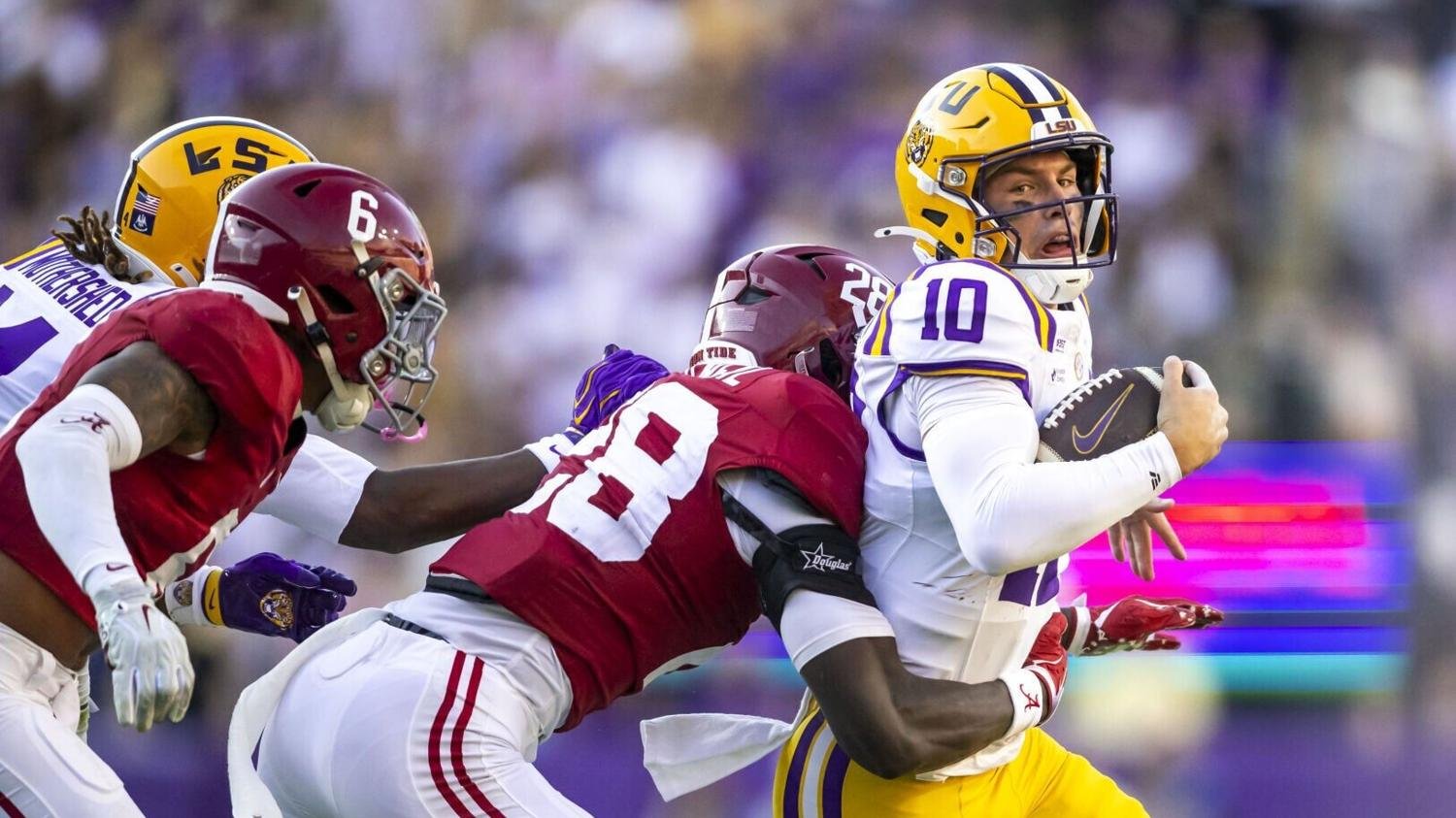
Alabama won the line of scrimmage. Besides stopping the run, the Crimson Tide also sacked Leavitt four times and pressured him 16 times, according to PFF.
“There were a couple of times,” Kiffin said, “where we didn’t protect him very well.”
LSU’s dominance up front on offense led to comfortable wins over Auburn and Mississippi State. The Tigers seemingly could do whatever they wanted because they dictated the terms of play, whether it was running the ball well enough to stay ahead of the sticks or generating big plays.
That wasn’t the case Saturday, even though the offense once again produced a lot of yards.
“I also kind of felt that it would probably be tough to run in general,” Kiffin said. “And our strength really has been throwing the ball with Sam and the receivers. And at times they really did that. We moved the ball really well at times in the game.
“It comes down to fourth downs and the red zone, or it’s much different.”
#LSU #football #struggles #red #zone #fourth #Alabama #LSU
Source link